In high school physics, where much of the work involves manipulating formulas and plugging in the appropriate values, students often focus on just trying to get the right answer. This is driven by their desire to complete their assignments as quickly as possible while achieving high grades. Little thought may go into the meaning behind their answers. While obtaining the right answer is important, the ability to explain how they arrive at that answer is equally, if not more, crucial.
Without the ability to explain their answers, students can fall into the trap of rote memorization. They learn how to use formulas without understanding how they are applied and and what is behind their answers. Requiring students to provide an explanation helps them to develop a bridge between knowing and understanding, ensuring that students are not just passively absorbing information but are actively engaging with the concepts.
Newton’s laws of motion offer a variety of opportunities for students to develop the problem solving skills needed to analyze an object’s motion based on the forces acting on it. But simply plugging numbers into a formula to calculate an object’s acceleration is not enough. Students must understand and be able to explain why an object experiences a particular type of motion.
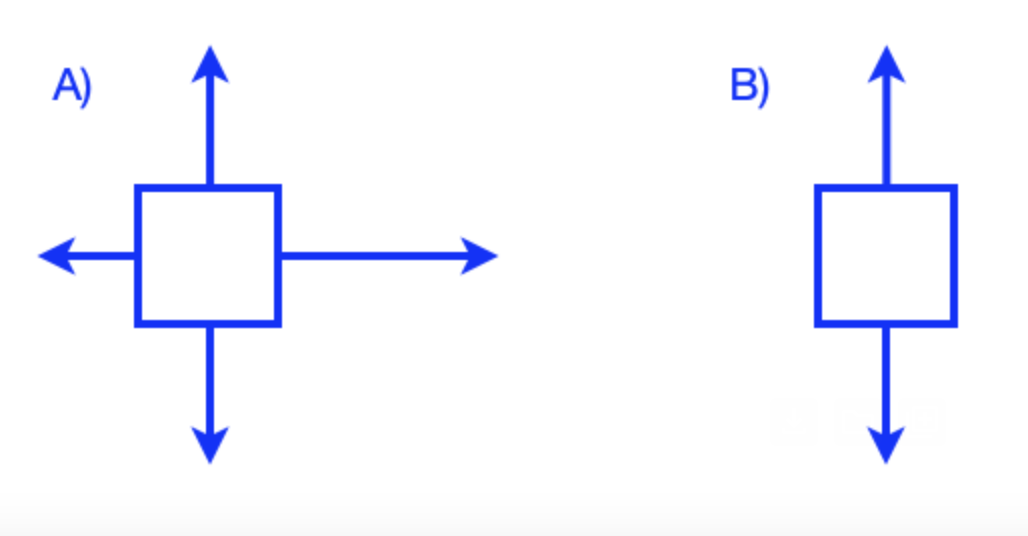
Shown above are two free body diagrams. Using Newton’s laws of motion my students must be able to describe the motion of each object and provide an explanation of how they arrived at their answer. Possible questions include: (1) which object could be at rest?, (2) if object A is moving to the right is it speeding up, slowing down or moving at a constant velocity? and (3) if object B is moving to the left is it speeding up, slowing down or moving at a constant velocity? As you can see the magnitude and type of each force is not given, so no calculations are allowed.
Instead, students must focus on their knowledge of balanced and unbalanced forces and the motion that results in each of the three situations described above. The forces acting on diagram A are unbalanced and the net force is to the right. Therefore, it must be accelerating and if it is moving to the right then it is speeding up because the net force also acts in this direction. The forces acting on diagram B are balanced; the net force is zero newtons. Therefore, it could be at rest. But if it is moving to the left (or in any direction for that matter) then it must be moving with a constant velocity.
This practice of explaining their answers encourages students to question assumptions, analyze the content of a problem, and think logically through each step of their solution. These are the hallmarks of critical thinking, a skill that is essential not only in science but in decision-making processes throughout life.
 Step by Step Science